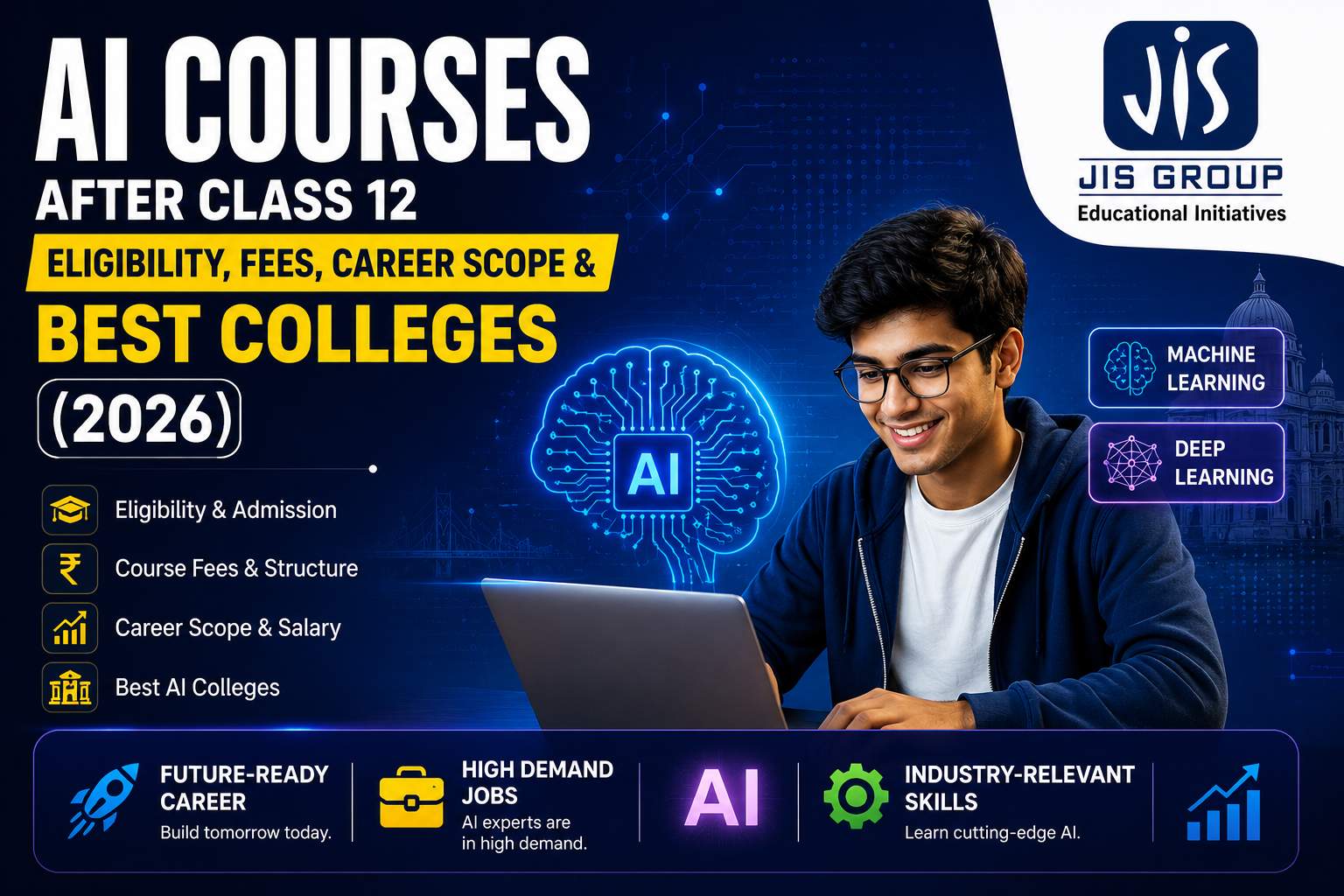
Artificial Intelligence (AI) has transformed from a futuristic concept into one of the fastest-growing career domains in the world. From healthcare and finance to robotics, cybersecurity, education, and entertainment, AI is changing how industries operate. As a result, many students are now searching for AI Courses After Class 12 in Kolkata to begin a rewarding career in technology.
If you have recently completed Class 12 and are interested in programming, data, automation, machine learning, or problem-solving, pursuing one of the AI Courses After Class 12 in Kolkata could be the ideal choice. Kolkata has emerged as an educational destination offering quality engineering and technology programs with modern laboratories, experienced faculty, industry collaborations, and placement opportunities.
This guide explains everything you need to know about AI courses, including eligibility, admission process, course fees, syllabus, career opportunities, salary expectations, and how to choose the right college.
Quick Answer
Which AI course is best after Class 12?
For students who want a professional career in Artificial Intelligence, the best options include:
-
B.Tech in Artificial Intelligence
-
B.Tech in Artificial Intelligence & Machine Learning
-
B.Tech in Computer Science with AI
-
B.Sc. Artificial Intelligence
-
Integrated AI Degree Programs
Among these, B.Tech in Artificial Intelligence is generally the most preferred choice because it combines engineering fundamentals with practical AI applications.
Why Choose AI Courses After Class 12?
Artificial Intelligence is no longer limited to research laboratories. Today, AI powers:
-
Virtual assistants
-
Self-driving vehicles
-
Medical diagnosis systems
-
Banking fraud detection
-
Recommendation engines
-
Smart manufacturing
-
Robotics
-
Smart cities
Organizations across every industry require professionals who understand AI technologies. This increasing demand has made AI Courses After Class 12 in Kolkata an attractive option for students looking for future-ready careers.
Major reasons students choose AI include:
-
High demand across industries
-
Excellent salary packages
-
Global career opportunities
-
Continuous innovation
-
Strong research prospects
-
Entrepreneurial opportunities
What Are AI Courses?
AI Courses focus on developing intelligent computer systems capable of learning, analyzing information, making decisions, and solving complex problems.
Students learn technologies such as:
-
Artificial Intelligence
-
Machine Learning
-
Deep Learning
-
Data Science
-
Computer Vision
-
Natural Language Processing
-
Robotics
-
Neural Networks
-
Python Programming
-
Cloud Computing
These technologies are now considered among the most valuable technical skills worldwide.
Why Study AI Courses After Class 12 in Kolkata?
Kolkata has become one of Eastern India's major education and technology hubs. The city offers quality higher education, affordable living costs, expanding IT infrastructure, and excellent academic institutions.
Benefits include:
Quality Education
Many engineering institutions now offer specialized AI programs aligned with current industry requirements.
Growing IT Industry
Students benefit from internship opportunities with software companies, startups, research organizations, and multinational corporations.
Affordable Education
Compared with several metropolitan cities, Kolkata often offers quality education at relatively lower tuition and living expenses.
Industry Exposure
Many colleges organize:
-
AI workshops
-
Hackathons
-
Coding competitions
-
Industry seminars
-
Live projects
-
Internship programs
These experiences help students become job-ready before graduation.
Eligibility for AI Courses After Class 12
Eligibility varies slightly among institutions, but the common requirements include:
Educational Qualification
Candidates should have completed Class 12 from a recognized board.
Subjects Required
Most B.Tech AI programs require:
-
Physics
-
Chemistry
-
Mathematics
Some B.Sc. AI programs may have different eligibility criteria.
Minimum Marks
Many institutions require approximately:
-
45–60% aggregate marks
-
Relaxation may be available according to institutional policies.
Entrance Examinations
Admission may be based on:
-
National entrance examinations
-
State-level entrance tests
-
University entrance examinations
-
Merit-based admissions
Students should always verify the latest admission guidelines of their preferred institution.
Types of AI Courses Available After Class 12
Students can choose from multiple academic pathways depending on their interests.
B.Tech in Artificial Intelligence
Duration: 4 Years
Suitable for students interested in software development, AI engineering, robotics, and advanced computing.
Core subjects include:
-
Programming
-
Algorithms
-
Machine Learning
-
Artificial Intelligence
-
Data Structures
-
Database Systems
B.Tech in Artificial Intelligence & Machine Learning
This specialized engineering program combines AI with machine learning techniques and predictive analytics.
Students gain practical knowledge of:
-
Intelligent systems
-
Neural networks
-
Data modeling
-
AI applications
B.Tech Computer Science with AI Specialization
This option provides a broader computer science foundation while allowing students to specialize in Artificial Intelligence during later semesters.
B.Sc. Artificial Intelligence
Students who prefer a science-focused undergraduate program may consider B.Sc. AI, depending on the college's curriculum and admission requirements.
Skills You Develop During AI Courses
A well-designed AI curriculum focuses on both technical and professional development.
Students learn:
-
Python Programming
-
Data Analysis
-
Logical Thinking
-
Machine Learning Algorithms
-
Deep Learning
-
Database Management
-
Cloud Computing
-
Software Development
-
Team Collaboration
-
Communication Skills
-
Research Methods
-
Problem Solving
These skills prepare graduates for careers across multiple technology sectors.
Typical AI Course Syllabus
Although syllabi vary by institution, students generally study:
First Year
-
Engineering Mathematics
-
Programming Fundamentals
-
Physics
-
Engineering Graphics
-
Basic Electronics
-
Communication Skills
Second Year
-
Data Structures
-
Database Management Systems
-
Operating Systems
-
Object-Oriented Programming
-
Computer Networks
Third Year
-
Artificial Intelligence
-
Machine Learning
-
Data Mining
-
Computer Vision
-
Natural Language Processing
-
Cloud Computing
Final Year
-
Deep Learning
-
Robotics
-
AI Projects
-
Industrial Internship
-
Capstone Project
-
Elective Subjects
The curriculum combines classroom learning with practical laboratory work and project-based education.
Is Artificial Intelligence a Good Career After Class 12?
Yes.
Artificial Intelligence remains one of the fastest-growing technology domains globally. Businesses increasingly rely on automation, predictive analytics, intelligent decision-making, and AI-powered software solutions.
Professionals with AI skills are employed across:
-
Healthcare
-
Banking
-
Manufacturing
-
Retail
-
E-commerce
-
Automotive
-
Education
-
Telecommunications
-
Government organizations
-
Research institutions
This broad industry adoption makes AI one of the most promising career choices for students after Class 12.
AI Course Fees in Kolkata
One of the most common questions students ask is, "How much do AI courses cost after Class 12?" The answer depends on the type of institution, course, and available facilities.
The approximate fee structure is:
|
Course |
Approximate Duration |
Estimated Fee Range |
|
B.Tech in Artificial Intelligence |
4 Years |
₹3 lakh – ₹10 lakh |
|
B.Tech AI & Machine Learning |
4 Years |
₹3.5 lakh – ₹12 lakh |
|
B.Sc. Artificial Intelligence |
3 Years |
₹1.5 lakh – ₹5 lakh |
Apart from tuition fees, students should also consider:
-
Hostel charges
-
Examination fees
-
Laboratory fees
-
Library charges
-
Project expenses
-
Transportation (if applicable)
Many institutions also offer scholarships, merit-based financial assistance, and education loan support.
Admission Process for AI Courses After Class 12 in Kolkata
The admission process generally follows these steps:
Step 1: Complete Class 12
Students should complete Higher Secondary education with the required subjects, especially Physics, Chemistry, and Mathematics for engineering programs.
Step 2: Check Eligibility
Different colleges may have varying eligibility requirements, including minimum qualifying marks and entrance examination criteria.
Step 3: Apply for Admission
Students can apply through:
-
University admission portals
-
Entrance examination counselling
-
Direct institutional application (where applicable)
Step 4: Document Verification
Generally required documents include:
-
Class 10 Marksheet
-
Class 12 Marksheet
-
Entrance Examination Scorecard (if applicable)
-
Passport-size photographs
-
Identity proof
-
Address proof
-
Category certificate (if applicable)
Step 5: Fee Payment & Enrollment
After document verification and seat confirmation, students complete admission by paying the required fees.
Best AI Colleges in Kolkata
Students searching for AI Courses After Class 12 in Kolkata should evaluate colleges based on more than rankings.
Consider institutions that offer:
-
Modern AI laboratories
-
Updated curriculum
-
Experienced faculty
-
Industry collaborations
-
Internship opportunities
-
Placement assistance
-
Research facilities
-
Coding clubs
-
Innovation centers
-
Startup incubation support
Instead of focusing only on college names, students should compare academic quality, infrastructure, practical exposure, and career support.
AI Course vs Computer Science: Which Is Better?
Many students are confused between Artificial Intelligence and Computer Science.
|
Artificial Intelligence |
Computer Science |
|
Specialized field |
Broad discipline |
|
Focuses on intelligent systems |
Covers all computing concepts |
|
Includes Machine Learning |
Includes software engineering |
|
AI-driven applications |
General software development |
|
Ideal for future AI careers |
Suitable for multiple IT careers |
If your goal is to build intelligent applications, automation systems, robotics, or machine learning solutions, AI specialization can be an excellent choice. If you prefer a broader technical education with flexibility across software domains, Computer Science remains a strong option.
Career Opportunities After AI Courses
The demand for AI professionals continues to grow globally.
Graduates can work as:
-
Artificial Intelligence Engineer
-
Machine Learning Engineer
-
Data Scientist
-
AI Research Associate
-
Robotics Engineer
-
Computer Vision Engineer
-
NLP Engineer
-
Software Engineer
-
AI Consultant
-
Data Analyst
-
Business Intelligence Developer
-
Automation Engineer
AI professionals are employed by:
-
Technology companies
-
Healthcare organizations
-
Financial institutions
-
Automobile manufacturers
-
E-commerce companies
-
Government agencies
-
Research laboratories
-
Educational institutions
-
Manufacturing industries
-
Cybersecurity firms
Salary After AI Courses
Salary depends on education, technical skills, projects, internships, certifications, employer, and location.
Approximate salary ranges in India:
|
Experience |
Estimated Annual Salary |
|
Fresh Graduate |
₹4–8 LPA |
|
2–5 Years |
₹8–15 LPA |
|
5–10 Years |
₹15–30+ LPA |
|
Senior AI Specialists |
₹30 LPA and above |
Professionals with expertise in Machine Learning, Deep Learning, Cloud Computing, and Data Engineering often command higher salaries.
Skills Employers Look For
Completing an AI degree is only one part of becoming job-ready. Employers also value practical skills such as:
Programming Languages
-
Python
-
Java
-
C++
-
SQL
AI Technologies
-
Machine Learning
-
Deep Learning
-
Neural Networks
-
Natural Language Processing
-
Computer Vision
Development Tools
-
TensorFlow
-
PyTorch
-
Scikit-learn
-
Jupyter Notebook
-
Git
Soft Skills
-
Communication
-
Teamwork
-
Critical Thinking
-
Creativity
-
Leadership
-
Analytical Skills
Students who work on real-world projects and internships often gain a competitive advantage during placements.
Emerging Trends in Artificial Intelligence
Artificial Intelligence continues to evolve rapidly. Some of the most exciting areas include:
-
Generative AI
-
Autonomous Vehicles
-
Healthcare AI
-
AI-powered Cybersecurity
-
AI in Finance
-
Smart Manufacturing
-
Robotics Automation
-
Edge AI
-
Explainable AI
-
Responsible AI
Professionals with expertise in these emerging technologies are expected to remain in high demand over the coming years.
Is AI Better Than Traditional Engineering?
There is no universal answer because the best course depends on a student's interests and career goals.
AI may be suitable for students who enjoy:
-
Mathematics
-
Programming
-
Technology
-
Innovation
-
Data Analysis
-
Automation
-
Problem Solving
Traditional engineering branches continue to offer excellent career opportunities, but AI provides specialized knowledge aligned with the increasing adoption of intelligent technologies across industries.
Why AI Is a Future-Proof Career
Artificial Intelligence is expected to remain one of the fastest-growing technology domains due to its applications in nearly every industry.
Organizations are increasingly investing in:
-
Intelligent automation
-
Predictive analytics
-
Smart healthcare
-
Financial technology
-
Industrial robotics
-
Personalized education
-
Digital transformation
As AI adoption grows, skilled professionals are likely to benefit from expanding career opportunities and continuous technological innovation.
How to Choose the Right AI College in Kolkata
Selecting the right college is just as important as choosing the right course. Instead of focusing only on rankings, evaluate the overall learning experience and career support offered by the institution.
1. Accreditation and Recognition
Choose a college that is approved by the appropriate regulatory authorities and follows an industry-relevant curriculum.
2. Updated AI Curriculum
Artificial Intelligence evolves rapidly. A good college should regularly update its syllabus to include:
-
Machine Learning
-
Deep Learning
-
Generative AI
-
Data Science
-
Cloud Computing
-
Computer Vision
-
Natural Language Processing (NLP)
3. Experienced Faculty
Faculty members with academic expertise and industry experience can provide valuable practical insights.
4. Laboratory Facilities
Hands-on learning is essential. Look for institutions with:
-
AI Labs
-
Programming Labs
-
Robotics Labs
-
Innovation Centers
-
High-performance Computing Facilities
5. Industry Exposure
Practical exposure through internships, hackathons, coding competitions, workshops, seminars, and live projects helps students build real-world skills.
6. Placement Support
Review the college's placement assistance, recruiter network, internship opportunities, and career guidance services.
Future Scope of Artificial Intelligence
Artificial Intelligence is expected to become one of the most influential technologies of the next decade. AI is already transforming industries by improving efficiency, automation, and decision-making.
Some sectors experiencing significant AI adoption include:
-
Healthcare
-
Banking and Financial Services
-
Manufacturing
-
Retail and E-commerce
-
Agriculture
-
Logistics
-
Cybersecurity
-
Education
-
Automotive
-
Media and Entertainment
As businesses continue investing in AI-driven solutions, demand for skilled professionals is expected to remain strong.
Common Myths About AI Courses
Myth 1: AI Is Only for Coding Experts
Reality: Programming is important, but AI also involves mathematics, logical thinking, data analysis, and problem-solving. Students develop these skills throughout their degree.
Myth 2: AI Will Replace All Jobs
Reality: AI is more likely to automate repetitive tasks while creating new career opportunities in technology, analytics, healthcare, finance, education, and research.
Myth 3: Only Computer Science Students Can Learn AI
Reality: Students from various educational backgrounds can pursue AI-related programs, depending on the course requirements and eligibility criteria.
Myth 4: AI Has Limited Career Options
Reality: AI professionals are employed across numerous industries, making it one of the most versatile career paths today.
Frequently Asked Questions (FAQ)
Which AI course is best after Class 12?
The most popular option is B.Tech in Artificial Intelligence or B.Tech in Artificial Intelligence and Machine Learning, as these programs provide a comprehensive engineering education with specialized AI knowledge.
Can I study AI after Class 12?
Yes. Students who have completed Class 12 and meet the eligibility requirements can pursue undergraduate AI courses offered by many colleges and universities.
What subjects are required for AI courses?
For most engineering-based AI programs, students should have studied Physics, Chemistry, and Mathematics in Class 12.
What is the duration of an AI course?
-
B.Tech AI: 4 Years
-
B.Sc. AI: 3 Years
The duration depends on the program and institution.
Is Artificial Intelligence a good career?
Yes. AI is one of the fastest-growing career fields with opportunities in software development, healthcare, finance, robotics, cybersecurity, and research.
What skills are needed for AI?
Students benefit from developing:
-
Programming
-
Mathematics
-
Logical reasoning
-
Data analysis
-
Communication
-
Problem-solving
-
Machine Learning fundamentals
Can Commerce or Arts students study AI?
Some diploma and certificate AI courses are open to Commerce and Arts students. However, most B.Tech AI programs require Mathematics in Class 12.
What is the average salary after an AI degree?
Entry-level AI professionals in India typically earn around ₹4–8 LPA, with salaries increasing based on skills, experience, and specialization.
Does AI require advanced mathematics?
Mathematics plays an important role in AI, especially topics such as algebra, calculus, probability, and statistics. These concepts are taught progressively during the course.
Which industries hire AI professionals?
AI professionals are employed in:
-
Healthcare
-
Banking
-
E-commerce
-
Manufacturing
-
IT Services
-
Robotics
-
Telecommunications
-
Government
-
Research Organizations
Is AI better than Computer Science?
AI is a specialization within Computer Science. Students interested specifically in intelligent systems and machine learning may prefer AI, while Computer Science provides a broader foundation across multiple computing disciplines.
Can I pursue higher studies after an AI degree?
Yes. Graduates can pursue postgraduate programs such as M.Tech, M.Sc., MBA, or research degrees in Artificial Intelligence, Machine Learning, Data Science, Robotics, and related fields.
Final Thoughts
Artificial Intelligence has emerged as one of the most promising career domains for students completing Class 12. With applications spanning healthcare, finance, manufacturing, education, transportation, and many other sectors, AI professionals are increasingly in demand across the world.
For students exploring AI Courses After Class 12 in Kolkata, choosing a program with a strong academic curriculum, practical learning opportunities, experienced faculty, and industry exposure can provide a solid foundation for future success. Beyond selecting the right course, students should focus on building programming skills, participating in projects, gaining internship experience, and staying updated with the latest developments in AI.
As AI technologies continue to evolve, graduates who combine technical expertise with continuous learning and problem-solving abilities will be well-positioned for rewarding careers in one of the world's fastest-growing fields.