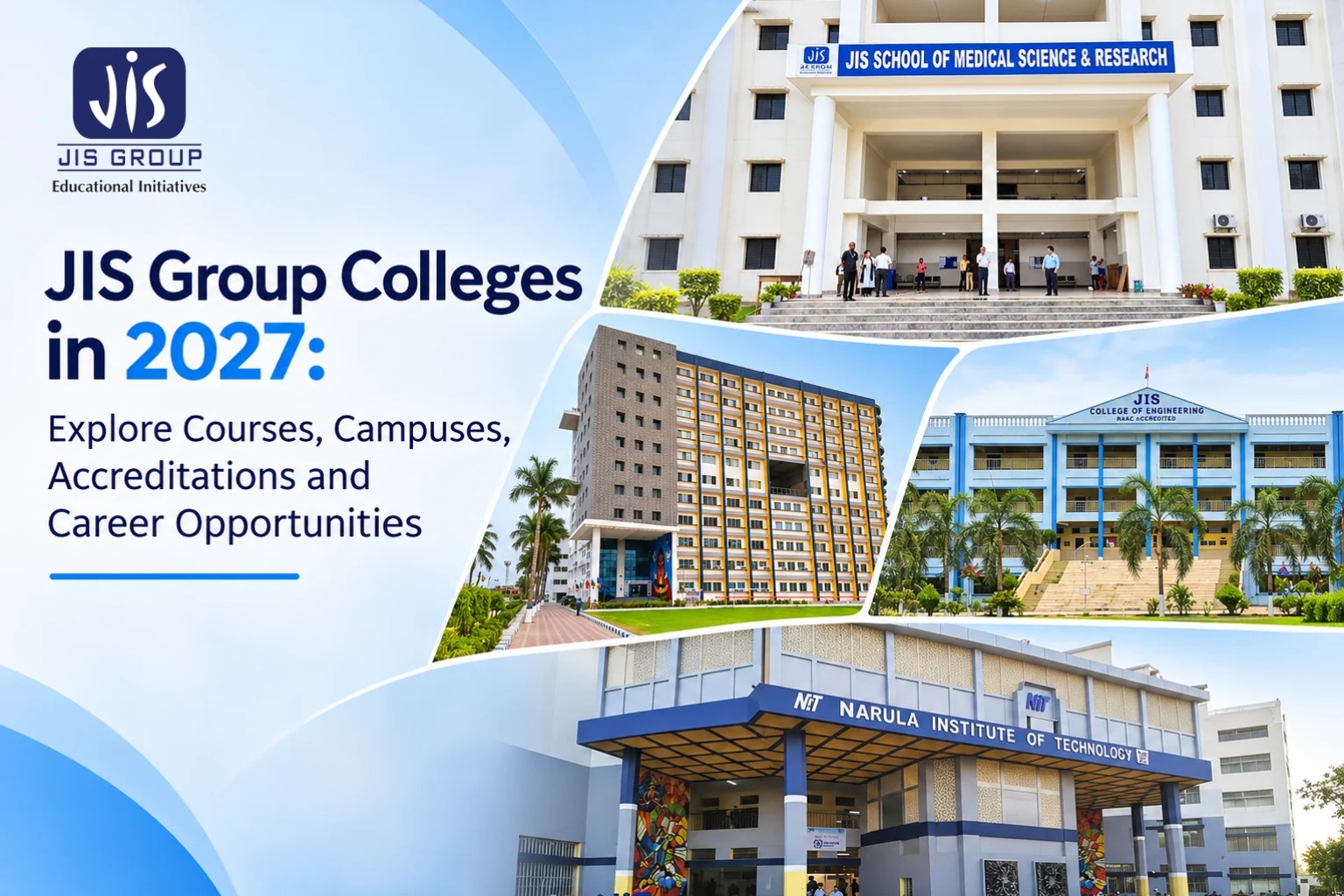
It's already the end of 2026, and if you're studying in Class 12, the next few months are going to be important.
Between preparing for board examinations, thinking about entrance tests and discussing your future with family, there's one question that keeps coming up.
"Which college should I choose after Class 12?"
Maybe you've already decided to pursue engineering but are confused between CSE, AI & Machine Learning and Electronics. Perhaps Biology is your favourite subject, and you're considering medicine or pharmacy. Or maybe you're still figuring out which career path interests you.
With so many courses and colleges to compare, it's natural to feel unsure.
But choosing a college shouldn't be about following your friends or picking whichever course seems most popular. It's about understanding what you want to learn and finding an institution that supports that direction.
If you're exploring JIS Group colleges for admission in 2027, you'll come across institutions offering programmes in engineering, medical sciences, pharmacy, management, hospitality and several other disciplines.
So, where should you begin?
Let's start with your interests and explore the options available.
One Educational Group, But Different Career Paths to Explore
Think about three students preparing for their Class 12 examinations.
One loves solving programming problems. Another enjoys Biology and wants to work in healthcare. The third dreams of starting a business someday.
Their ambitions are different, so their higher education choices should probably be different too.
This is where understanding a larger educational network becomes useful.
Over more than two decades, JIS Group has developed a network spanning different areas of higher and professional education. According to its official institutional information, the group now includes 39 institutions offering more than 185+ academic programmes, with a student community exceeding 45,000.
But what do these numbers mean for someone choosing a college?
They show the range of academic options available within the network. You can explore engineering at one institution, medical education at another, or consider pharmacy, management, hospitality and other courses according to your interests.
Of course, belonging to a large educational group doesn't automatically make every course the right choice for every student.
You still need to understand the curriculum, campus facilities, accreditation, eligibility and career-related opportunities of the institution you're considering.
And for many students, that journey begins with engineering.
Planning to Study B.Tech in 2027? Explore These Four Engineering Colleges
You probably know someone who wants to study Computer Science because they enjoy coding.
Another friend might prefer Electronics because they want to understand how devices and communication systems work.
And someone else might be interested in Mechanical or Electrical Engineering.
Even within engineering, there's no single path that suits everyone.
Among the major JIS Group engineering institutions, Narula Institute of Technology, Guru Nanak Institute of Technology, JIS College of Engineering and SURTECH are worth exploring.
Narula Institute of Technology (NIT)
Location: Agarpara, Kolkata
Suppose you're interested in technology but haven't decided whether Computer Science, Information Technology or another engineering discipline would suit you.
You might want to understand how much coding each course involves, what you'll study in the laboratories and how the subjects change over four years.
Narula Institute of Technology offers undergraduate and postgraduate programmes across several engineering disciplines, including Computer Science and Engineering, Information Technology, Electronics and Communication Engineering, Electrical Engineering and Mechanical Engineering.
For example, CSE introduces students to programming, algorithms and computing systems, while Electrical Engineering focuses on areas such as circuits, electrical machines and power systems.
Both are engineering courses, but they involve different kinds of learning.
That's why understanding the syllabus matters.
Instead of choosing a branch because its name sounds familiar, look at what students actually study and whether those subjects match your interests.
Guru Nanak Institute of Technology (GNIT)
Location: Sodepur, Kolkata
You've probably used AI tools or heard people discussing cybersecurity.
But have you wondered what studying these technologies actually involves?
Does an AI & Machine Learning course require advanced coding from the beginning? What is the difference between general CSE and Cyber Security? And what exactly do Food Technology students learn?
Guru Nanak Institute of Technology offers programmes across Computer Science and Engineering, AI & Machine Learning, Cyber Security, Electronics and Computer Science, Electrical Engineering, Food Technology and other technical disciplines.
Some of these options may introduce you to subjects you hadn't considered before.
Take Food Technology, for instance.
It's not simply about preparing food. The discipline involves understanding food processing, preservation, scientific testing and quality control.
Similarly, Cyber Security is much broader than identifying hackers. Students develop computing fundamentals and learn about the security of digital systems and information.
If you're exploring GNIT for 2027, compare the actual subjects of the programmes that interest you.
A specialised course may sound exciting, but it's worth knowing what you'll be studying before committing to it.
JIS College of Engineering (JISCE)
Location: Kalyani, West Bengal
Remember those school science experiments where a difficult concept suddenly made sense once you saw it happen?
Perhaps you enjoyed assembling a circuit or finding out why a particular experiment produced a certain result.
If you enjoy applying what you've learned, practical education is something you should pay attention to when comparing colleges.
JIS College of Engineering offers programmes across Computer Science, Information Technology, Electronics, Electrical Engineering and other technical disciplines.
Engineering education involves more than attending lectures. Laboratory exercises, assignments and technical projects help students connect classroom concepts with practical applications.
For example, learning how a computer program works is useful. Writing and testing that program can make the concept much clearer.
When considering JISCE, explore the curriculum and department-level learning opportunities rather than looking only at the college's name.
Dr. Sudhir Chandra Sur Institute of Technology & Sports Complex (SURTECH)
Location: Dum Dum, Kolkata
What if you're interested in engineering but haven't decided which branch is right for you?
Maybe you enjoy working with computers, but you're also curious about electronics, machines or the design of physical structures.
SURTECH offers engineering programmes across different technical disciplines, including Computer Science, Electronics and Civil Engineering, subject to current programme availability.
Each discipline approaches technical problems differently.
Civil Engineering involves understanding structures, materials and infrastructure. Electronics-related courses examine circuits, devices and technical systems.
Before choosing a branch, think about the problems you'd enjoy learning to solve.
That can tell you much more about a course than its popularity.
Accreditation and Affiliation: What Should You Actually Check?
By now, you may have shortlisted two or three engineering colleges.
All offer your preferred course, and each has information about laboratories, placement support and academic activities.
But while browsing their websites, you've probably noticed terms like NAAC, NBA, AICTE and MAKAUT.
What do they mean?
Let's make it simple.
NAAC accreditation assesses higher education institutions, while NBA accreditation applies to specific academic programmes.
AICTE approval relates to the regulatory framework applicable to technical education, and MAKAUT affiliation refers to the university relationship of several engineering institutions in West Bengal.
For example, NIT reports NAAC Grade A accreditation, while GNIT holds NAAC A+. JISCE and SURTECH also report NAAC Grade A accreditation. These institutions have relevant MAKAUT affiliations and AICTE approvals, with NBA accreditation applying to selected programmes.
But here's something students should know: if a college has NBA-accredited engineering programmes, it doesn't mean every programme automatically has that status.
That's why checking official documents matters.
When comparing your options, use the published records for NIT, GNIT, JISCE and SURTECH to verify the applicable accreditation, approval and affiliation details.
For 2027 admissions, make sure the information is current and applies to the particular course you're considering.
What About Placements and Career Opportunities?
Let's talk about something students and parents naturally want to know.
"What happens after graduation?"
It's a reasonable question.
After spending several years studying for a degree, you'll want to understand the professional opportunities that may be available.
But imagine seeing a college advertise an impressive highest salary package.
It catches your attention immediately.
Then you realise you don't know how many students were actually placed or which branches the offers came from.
That's why official placement records are more useful than relying on one headline figure.
For example, JIS College of Engineering reported the following results for its four-year undergraduate programmes in 2024–25, according to its NIRF 2026 institutional submission:
-
752 students graduated within the stipulated time.
-
578 students were placed.
-
The median salary of placed graduates was ₹6 lakh per annum.
These numbers help explain what the institution reported for a particular graduating batch. They aren't a guarantee of employment or salary for students joining in 2027.
Other institutions, including NIT, GNIT and SURTECH, also provide campus training and recruitment-related information. GNIT's year-wise placement records, for example, offer another source for students examining recruitment activity.
The wider JIS Group also reports collaborations with more than 550 industry partners, alongside academic connections with universities overseas.
These relationships may create opportunities for activities such as projects, professional interaction or academic collaboration, depending on the institution and programme. They should not be confused with guaranteed internships, international exchanges or job offers.
When researching placements, consider more than the highest salary.
Look at the number of students placed, the relevant graduating batch, internship and training arrangements, and the skills students are encouraged to develop.
Your projects, technical knowledge, communication skills and preparation will also matter when you begin exploring career opportunities.
What If Your Dream Is to Become a Doctor?
Now let's move away from engineering.
Perhaps Biology has always been your favourite subject.
You enjoy learning about the human body, understanding diseases and discovering how medical treatment works.
Maybe you've already started preparing for NEET.
For students interested in pursuing MBBS, JIS School of Medical Science & Research (JISMSR) in Santragachi, Howrah, is an important institution within the JIS Group network.
Medical education involves foundational sciences, laboratory learning and progressively developing clinical training.
Students learn subjects such as Anatomy, Physiology and Biochemistry before moving into more advanced medical disciplines.
JISMSR is affiliated with JIS University. Its published MBBS admission information states that the programme had National Medical Commission (NMC) approval for the specified 2026 intake.
Students planning for 2027 should verify the applicable NMC permission, seat intake, NEET-UG requirements and counselling procedures.
Are Medical College Placements Different?
Yes, medical education follows a different professional pathway from engineering campus recruitment.
MBBS students complete the prescribed academic programme and compulsory rotating internship before progressing through the applicable professional registration and career pathways.
Because JISMSR started its MBBS programme in 2023, it doesn't yet have the long history of completed graduating batches available at older engineering institutions.
For medical aspirants, reviewing the teaching hospital, clinical training opportunities, faculty and regulatory recognition is especially important.
What If You're Interested in Something Beyond Engineering or MBBS?
Not every Science student wants to become an engineer or doctor.
And not every student wants to study Science after Class 12.
Perhaps you're interested in business, law, pharmacy, hospitality or research.
The wider JIS Group network includes institutions catering to these different interests.
JIS University: For Students Exploring Different Academic Disciplines
Imagine you enjoy Biology but aren't sure whether to pursue Biotechnology, Microbiology or another science-related programme.
Or perhaps you're interested in technology but would prefer a different academic pathway.
JIS University offers programmes across Engineering, Science, Pharmacy, Management, Law, Agriculture and other disciplines.
This gives students several undergraduate and postgraduate options to investigate.
For example, Microbiology focuses on microorganisms and their applications, while Biotechnology explores biological systems and processes.
If you're considering JIS University, compare programme subjects and eligibility requirements before deciding which direction suits you.
Pharmacy, Dentistry and Veterinary Science: Different Healthcare Pathways
Have you ever wondered how medicines are formulated or tested before reaching patients?
If that interests you, pharmacy may be worth exploring.
Guru Nanak Institute of Pharmaceutical Science & Technology (GNIPST) offers pharmacy education through undergraduate and postgraduate pathways.
If oral healthcare interests you, Guru Nanak Institute of Dental Sciences & Research (GNIDSR) offers professional dental education, including BDS and MDS programmes.
And if you love animals and want to understand their healthcare, JIS College of Veterinary & Animal Sciences (JISCOVAS) offers a B.V.Sc. & A.H. pathway.
These courses prepare students for different professional responsibilities.
Each also has its own academic structure, eligibility and regulatory requirements, which should be checked before applying.
Management, Hospitality and Research: Other Directions Worth Exploring
Maybe you enjoy planning events, organising activities or thinking about how businesses operate.
Management education could be an interesting option.
JIS School of Management Studies offers management-related academic programmes, while JIS University also provides programmes in business and management.
For students interested in hotels, food production, hospitality operations and guest experiences, Guru Nanak Institute of Hotel Management (GNIHM) offers relevant academic pathways.
And if you later develop an interest in advanced scientific study, JIS Institute of Advanced Studies & Research (JISIASR) provides postgraduate and research-oriented opportunities.
The important thing isn't to add every possible course to your shortlist.
It's to understand enough about the available options so that you don't overlook something you might genuinely enjoy studying.
How Can You Choose the Right JIS Group College for 2027?
Let's say you've finally shortlisted three colleges.
Each offers a course you're interested in.
What should you compare next?
Start with the curriculum.
If you're considering Computer Science, look at the subjects taught across different semesters. If you're exploring healthcare, understand the academic and practical training requirements.
Then review the facilities associated with the course.
Engineering students may need to consider laboratory and project opportunities. Medical and dental aspirants should pay attention to clinical learning environments.
Next, verify accreditation and affiliation.
A college's overall recognition and the approval status of a particular programme are not necessarily the same.
Placement or professional training information matters too.
Look at dated institutional records, understand the figures and avoid assuming that historical results predict your own future.
Finally, think about practical concerns.
Is the campus conveniently located? What are the total fees? Will you need accommodation? Does the course suit your academic interests and eligibility?
If possible, visit the campus or attend an official counselling session.
And before applying, check the admission requirements for 2027 rather than relying on previous-year information.
A thoughtful shortlist is much more useful than collecting dozens of college names without understanding what makes them different.
Your College Decision Doesn't Need to Happen Overnight
As 2026 comes to an end, you may still be comparing courses, researching campuses and discussing different possibilities with your family.
That's part of making an informed decision.
Whether you're interested in engineering at NIT, GNIT, JISCE or SURTECH, medical education at JISMSR, or programmes in science, pharmacy, dentistry, management and hospitality, JIS Group colleges offer different academic paths worth exploring.
But the right choice will depend on your interests, academic goals and circumstances.
So don't feel pressured to choose a course because everyone around you is choosing it.
Read the syllabus. Understand the accreditation. Explore the campus. Look beyond placement headlines.
And most importantly, ask yourself whether you're genuinely interested in what you'll be learning.
Because choosing a college isn't just about where you'll spend the next few years. It's about finding the direction you want to explore.
Frequently Asked Questions (FAQs)
1. How many colleges and programmes are offered under JIS Group?
According to its official institutional information, JIS Group includes 39 institutions offering more than 185 academic programmes, with over 45,000 students across its educational network.
2. Which are the major engineering colleges under JIS Group?
Major engineering institutions include Narula Institute of Technology (NIT), Guru Nanak Institute of Technology (GNIT), JIS College of Engineering (JISCE) and Dr. Sudhir Chandra Sur Institute of Technology & Sports Complex (SURTECH), alongside other institutions within the network.
3. Are JIS Group engineering colleges accredited and affiliated with MAKAUT?
Several engineering institutions have MAKAUT affiliation, AICTE approvals and NAAC accreditation. Selected engineering programmes also hold NBA accreditation. Students should verify the current status for their intended institution and course.
4. Do JIS Group colleges provide placement opportunities?
Several institutions provide training and campus recruitment support and publish placement-related information. Outcomes vary by college, programme, graduating batch and individual student preparation.
5. Is there an MBBS college under JIS Group?
Yes. JIS School of Medical Science & Research (JISMSR) in Santragachi, Howrah, offers an MBBS programme. Admission is subject to applicable NEET-UG, counselling, eligibility and regulatory requirements.
6. How should I choose a JIS Group college for admission in 2027?
Begin with the course that interests you. Compare the curriculum, campus facilities, accreditation, affiliation, placement or professional training information, fees and location. Verify the latest admission requirements before applying.